


Working with trainer Phil Schoenthal, Matt Dorman of Determined Stud was one of the more active buyers at the November breeding stock sales, where he purchased close to 20 mares for his new broodmare band. With a newly purchased farm in Maryland, Dorman has decided to expand his interests in the industry to include breeding as well as racing. BloodHorse MarketWatch spoke with Dorman about his history in the industry, why he decided to break into breeding, and why the recent decline of the commercial market means it's the perfect time to start a broodmare band.
MarketWatch: How did you first become involved in horse racing?
Matt Dorman: I am born and raised in Maryland, and my father used to take me to the track when I was younger. We would go to Bowie and Pimlico when I was little, and I would always go with him. As I got older, I wanted to get into it more, so when I could actually afford it, I bought into a low-level claimer that (trainer) Phil Schoenthal had so that I could get a better understanding of how it all works. Now I only use Phil, and it's been that way from the start.
MW: How many horses do you have in training?
MD: I race under D Hatman Thoroughbreds, and we've got about four or five now that are actually running, and then we have 11 yearlings we purchased in September that are with Jeff Murphy in Virginia. He's breaking them and getting them ready to be sent up here to Maryland. Of the five running, two of those I guess could be called our "bigger" horses. We're in Maryland, so they've all been at Laurel Park, but we are about to move up to Fair Hill in the spring, so we will be based out of there.
MW: What made you want to make the leap from racing to breeding?
MD: I think all angles of the industry are tricky, but part of it was the market. I think the market is having a tough year, and I'd much rather buy in a down year versus a strong year. I also sold my company earlier this year, so this was the next thing I wanted to do. I had a company for 20 years that I started, grew, and got it to the right level, so I cashed out a good chunk of it. It's just good timing.
My company was called Credible Behavioral Health, which was electronic health records for mental health. I had lost one of my sisters to an individual who was discharged from a psychiatric hospital, and there was no real community follow-up on this individual—just a paper record. I worked at Lockheed at the time, so I had a good understanding of technology and I was surprised with the court case and how much paperwork was involved and how many problems are out there regrading mental health that could be avoided with the use of technology. I started my company in 2000 and grew it into the second-largest of its kind in the U.S. and then sold it.
I still do some consulting for the company, but I just sold it in August, so I'm still in the first 100 days. I'm just enjoying spending time with my boys and obviously getting the horse business off the ground. We bought an old farm that we're renovating, and there is a lot of work to be done there as well. We will take a good amount of time to focus on the horses and the farm, and I'm very fortunate to be able to do what it is I'm doing. The farm and all the horses there will be what we've named Determined Stud.
MW: When it comes to building your broodmare band, is Phil your main bloodstock agent, or do you have a team that you work with?
MD: There are a couple other guys. Scott Mallory—he's a third-generation horseman, and his grandfather foaled Seattle Slew, so Scott is an awesome guy and very down to earth. He has all the horses we left in Kentucky, and he'll bring them up here to Maryland when they're ready. Then I work with David Wade, who runs Sycamore Hall and Northview Stallion Station up here in Maryland. He helps as well.
Prior to the sales, Phil did a lot of the work ahead of time, and we both went through the catalog and we had certain things we wanted in yearlings and broodmares, and then Scott and Dave jumped in to give their views. … They helped out with physical inspections as well, so it was really a team effort.
MW: Were you looking to purchase horses descending from certain families, or were you more focused on finding young, racy physicals?
MD: It's a combination. There are certain families that when we saw the pages, we wanted to get into them. There are also certain European lines that I'm a big fan of, and that was more with the yearlings we bought. For example, we got a beautiful filly that is related to Found, who was one of my favorite horses of all time. That was a combination of an amazing bloodline and "horse crush" that I had on that filly.
With the broodmares, we were looking for a balance of young horses with really good pages and strong dams that showed talent, or maybe their siblings were faster than average if you look at different ratings. Then we also looked for a couple older mares with decent records that we thought would be lower risk. We also joked that we were looking for some "blue-collar" mares that were just fast on the track. Those ended up being a bit pricier than we thought. At the January sale, we will be looking for those kinds of blue-collar horses as well.
MW: Did you have a preference for dirt or turf pedigrees?
MD: For the commercial side to be successful, people say you have to be dirt in America, and I understand that. At the same time, I've done fairly well on turf with different horses. So there is a percentage that if there is all-turf pedigree out there, I'm fine with that because if we end up racing that horse—even when there are more limited turf opportunities—I still think there is a pretty good market out there for turf.
MW: So the plan will be to sell all the foals through the commercial market?
MD: Ideally, the mares are all productive and produce good horses, and we're able to keep them for a long time. The colts we will sell, and the fillies we will have to scratch our heads to see if we want to sell them or keep them and run them.
MW: What is the cap-off number for your broodmare band, or is there a number at all?
MD: I think 15 is a good number. That said, I think we will be well north of that. If there is a good horse at a good price, to me it makes sense, and fortunately I have flexibility. Good broodmares don't come up as often as yearlings. You can always go to the yearling sales and find five or 10 Hard Spun s or whatever you're looking for. Broodmares are different. If the opportunity is there and it's something we are looking at, the farm I have is 400-plus acres, so I have plenty of room.
MW: Will you foal all the mares out in Maryland or split them between states?
MD: I think there is an opportunity to have really high-quality broodmares in Maryland bred to Kentucky sires, and we will foal them all in Maryland and take advantage of the program there. The ones in Kentucky now will come up as they're ready to foal.
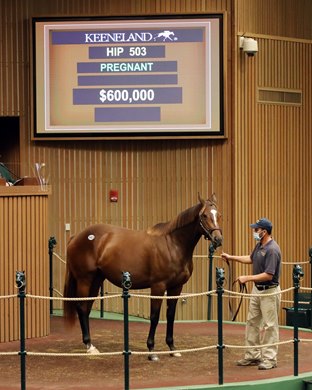
MW: What did you think of the state of the broodmare and weanling market in November, and did you find that it was greatly affected by COVID-19?
MD: I think Keeneland was stronger than I thought it would be. I thought it would be down 20-30% like the sales in Europe, but it was pretty strong. That being said, I think we got good prices on some but not all of the horses. But I'm happy for the folks that were selling.
We're still looking at some of the sales in Europe, and those market numbers do seem to be staying lower. There are some interesting lines over there that we don't have. There is also an interesting situation with Galileo, who is a phenomenal sire but he has dominated a lot of the lines over there to the point that people are having trouble finding out crosses. If we can find some decent ones and develop them here, I think that would greatly appeal to European buyers down the road. We are exploring that angle.
Oftentimes when economies contract, that is when there is the most opportunity. It's hard to see sometimes when you're in the thick of it, and it's much easier for me coming from a smaller operation and trying to go larger, versus the folks that have been doing this for 10-20 years who find it to be a really tough market. But overall, the industry has had a lot of challenges over the past five years, and COVID-19 has been just one more body blow. That can be hard on people, but there is opportunity. I think tracks need to modernize and come up with a better product. There are things they can do with the sport.
There is always room for high quality, and people will always pay. Unfortunately, if you're breeding your mare to a $1,000 stallion, you will get what you pay for. But if your mare and your stallion are at the higher end, you can see how strong the numbers are at market. Our approach is to try to avoid the middle and the bottom market. If we end up with horses that aren't commercial, we are fortunate we can race them and go from there. If they don't race well, there are programs that we work with who train horses for things like therapeutic care and others who will help them find good homes.