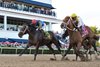

In the California wine country home of Robert and Barbara Walter, there was displayed above the great room's generous hearth a large painting of the finish of the 1996 Kentucky Derby (G1). The image was framed from underneath the inside rail, and from that angle the horse in the foreground was the apparent winner over the horse in the background, off to the left.
The horse in the foreground was Cavonnier; the horse in the background was Grindstone. The Walters owned Cavonnier, who actually lost that Derby by the slimmest measurable margin. In contemplation of the painting, a visitor remarked that the optical illusion created by the angle was comforting, but the constant reminder of the reality must be cause for melancholy.
"Not at all," Barbara Walter said. "Our boy ran a great race. That's what the painting celebrates. The result of the photo was another thing altogether."
Mental health being a priority, Barbara had the right idea. Horse racing can be a bitter pursuit, a game of half-ton beasts throwing themselves around to a result often measured in inches, or less. Bred, foaled, and raised right there at the Walters' Vine Hill Ranch, Cavonnier was a family pearl of great price, and if the nod went against him at Churchill Downs, well, that was just karma having a bad day.
Unfortunately, when it comes to photo finishes in racing, history leans hard into the catchphrase trademarked by the fictional NASCAR driver Ricky Bobby: "If you're not first, you're last." Grindstone never ran again, but "Derby winner" will follow his name through the ages. Cavonnier, on the other hand, is relegated to that great swamp of 3-year-olds who were not quite good enough or lucky enough on the day it counted most.
The bang-bang-bang finish of the May 4 Kentucky Derby brought Grindstone-Cavonnier to mind, along with the 1947 Derby that came down to a pair of heads separating Jet Pilot, Phalanx, and Faultless at the end of the mile and one-quarter over a track so slow from rain that it took 2:06 4/5 to complete the exercise. Jet Pilot got all the headlines, of course, but the analysis of the race rang familiar notes. Just as Mystik Dan took advantage of a ground-saving masterpiece by Brian Hernandez Jr., Jet Pilot and Eric Guerin were praised for their front-running tactics over ground that probably helped the winner last longer than he would have under normal circumstances. And just as Sierra Leone and Forever Young were bumping, grinding, and bearing down on Mystik Dan, Jet Pilot must have heard the hoofbeats of Faultless and Phalanx charging hard in the middle of the track.

On the other hand, Jet Pilot might have been a horse tapping into some kind of destiny. In the spring of 1946, he was among a large contingent of young horses owned by Elizabeth Arden Graham's Maine Chance Farm stabled at Arlington Park. In late April, when the stable's Star Pilot was shipped to Kentucky for the Derby, 2-year-old Jet Pilot went along for the ride, and that's where he was, safe and sound at Churchill Downs May 2 when a fire engulfed the Maine Chance barn at Arlington, killing 23 of Jet Pilot's stablemates.
(One of the survivors was the filly Beaugay, the champion 2-year-old filly in 1945 for whom the May 11 Beaugay Stakes (G3T) at Aqueduct Racetrack is named.)
The following afternoon at Churchill Downs, Jet Pilot won a maiden race, then one year later he returned to take the Derby—and never won again. As Joe Palmer put it in American Race Horses of 1947, "Really, all of his racing career that will be remembered, and all that Jet Pilot and his mistress would want to remember of it, extended from the dawn of one Derby Day to sunset of the next."
We always want to see more from a Derby winner, especially when a close finish renders judgments inconclusive. Grindstone came out of his Derby victory with an injury that ended his career. Jet Pilot finished fourth in the Preakness Stakes and fourth in the Withers Stakes, then retired with a bowed tendon. When the razor-thin winner abdicates, attention rightly turns to the horses who just missed, as if they can help fill the void.
In the case of Phalanx and Faultless, they both stepped up to keep the Derby story alive. Faultless, a son of Bull Lea from the Calumet Farm factory, won the Preakness, with Phalanx third, and came right back to take the Withers. Phalanx emerged from the Preakness to finish third in the Peter Pan Handicap, then one week later he romped by five lengths in the Belmont Stakes.
Faultless finished up the track in the Belmont, which was already his 12th start of the year. He had won eight times in that span, but he was clearly toast and needed a break. Phalanx, in the meantime, soldiered on to take the Dwyer Stakes at Aqueduct, the Empire City Stakes at Jamaica, and the Jockey Club Gold Cup back at Belmont by a nose over the Argentine horse Talon, who went on to win the 1948 Santa Anita Handicap. Rightfully, Phalanx was voted 3-year-old male champion of 1947, while out of the money only once in 16 starts.
After nearly a year on the sidelines, Phalanx returned to modest success as an older horse. He finished second to Citation in the 1948 Belmont Gold Cup and won a minor handicap at Jamaica, going 17 furlongs. Faultless came back at 4 and 5 to be part of a deep Calumet bench behind Citation, Coaltown, and Fervent, managing to win the Gallant Fox Handicap in New York and the Tropical Handicap in Florida to cap a 46-race career.
Cavonnier's post-Derby career was a checkered drama. He was hit with a football launched from the Pimlico Race Course infield and finished a well-beaten fourth in the 1996 Preakness, after which he bowed a tendon running the Belmont. The Walters treated the tendon with stem cell therapy and the gelding was brought back to the races with an improbable victory in the conditioned Ack Ack Stakes in late 1998. There ensued a series of layoffs and comebacks, for trainer Bob Baffert and then Ron McAnally, before Cavonnier raced for the last time in June of 2000. He retired that summer to Vine Hill Ranch, where he lorded over a pasture of bratty yearlings and made annual appearances at the Sonoma County Fair race meeting just down the road in Santa Rosa, Calif., for a race named in his honor.
It's a roll of the dice to guess what comes next for the three colts on the wire at the end of the 150th Kentucky Derby. Sierra Leone needs to work on his manners, although his tendency to lean left is probably baked into a stride that wings wildly with the left fore. Blinkers and bits might help, but he'll always need to be ridden defensively in the stretch.

As far as Japan's Forever Young is concerned, don't count on seeing him back on these shores before the Breeders' Cup Classic (G1) at Del Mar in November, but he is clearly worth the wait. As for the second leg of the Triple Crown May 18, not since Justify in 2018 has the Derby winner won the Preakness. Hopefully, Mystik Dan will be given the chance to restore some semblance of order to a series beset in recent years by the chaos of disqualifications, medication scandals, and pandemic disruption. That should not be too much to ask.