
Once upon a time (oh no, here he goes again), there was a race called the Hollywood Futurity. As the name suggests, it was intended as a glitzy preview of things to come—hopefully good things—designed for talented young Thoroughbreds whose enthusiasm for the chase was still fanciful and fresh.
Because the Futurity was run in the last half of December, a holiday spirit always filled the air. Fans drove to Hollywood Park on the west side of town through boulevards festooned with bright lights and decorations. They would leave the track and head for parties suited to the season, or straight to teeming malls. Christmas cheer would flow.
Chances are, they would have witnessed a special racehorse in the making, maybe even a future champion. Roving Boy, Snow Chief, Declan's Moon. Best Pal, Real Quiet, Captain Steve. Point Given, Brother Derek, King Glorious. Lookin At Lucky, Lion Heart, Shared Belief. They added considerable value to their Futurity triumphs.
There were even winners of the Hollywood Futurity who literally shaped the breed. In 1991, the low-headed, power-packed A.P. Indy won a narrow decision under an ice-cold Eddie Delahoussaye hand ride. In 2008, the margin was a nose between victorious Pioneerof the Nile and I Want Revenge. A.P. Indy went on to become a champion sire and broodmare sire, with more than two dozen sons at stud. Pioneerof the Nile sired American Pharoah.
By 2007, the Hollywood Futurity had become the CashCall Futurity, thanks to a handsome purse infusion from owner Paul Reddam. It was still the Hollywood Futurity in spirit, though, usually run under the lights on a chilly evening in Inglewood, Calif., and Reddam continued his sponsorship at Hollywood until the track was closed at the end of the 2013 December meet.
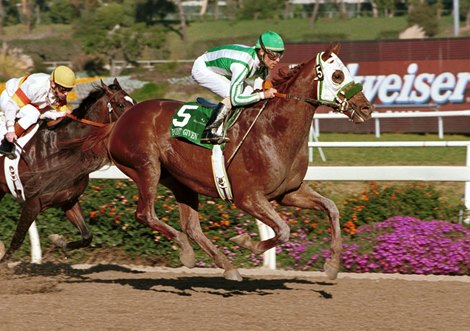
Now we have the Los Alamitos Futurity (G2), which in no way resembles the Hollywood Futurity in terms of purse, place, or competitive depth. Heck, it even takes an asterisk and a rounding error to keep from confusing the Los Alamitos Futurity for Thoroughbreds Dec. 13 with the Los Alamitos Two Million Futurity for Quarter Horses Dec. 14. The purse for the Los Alamitos Two Million Futurity is $1.9 million, but that's nitpicking.
For its 2019 running, the grade 1 rating of the Los Alamitos Futurity was knocked down a peg. In response, the purse was cut to $200,000, the minimum required to maintain consideration for a grade 2 rating. Another response would have been to increase the purse in an attempt to promote the Los Alamitos Futurity back to a glimmer of its old Hollywood Futurity days. But I'm guessing that option was not on the table.
The Futurity spent most of its 33-year run at Hollywood Park attracting both national attention and participation. Since it was revived at Los Alamitos, over the same 1 1/16 miles on an elongated Quarter Horse track, not so much.
The winners of the 11 Los Alamitos versions have come from the stables of just four trainers. Michael McCarthy, Doug O'Neill, and Tim Yakteen each have won one. Bob Baffert has won the rest.
In contrast, the winners of the final 11 CashCall/Hollywood Futurities offered at Hollywood Park emerged from nine different barns—those of Patrick Biancone, Ron Ellis, Dan Hendricks, William Currin, Richard Mandella, Peter Miller, Todd Pletcher, and Jerry Hollendorfer, plus three from Baffert.
And those races were considerably harder to win. The average field size of the last 11 at Hollywood Park was 9.6, which included two gates of 12 and one of 13. The last 11 at Los Alamitos have averaged 5.2 starters, including one field of four. Of the 58 young horses who have run in the Los Alamitos Futurity in the last 11 years, 23 were trained by Baffert.
Such numbers are depressing for fans and discouraging for serious horseplayers. Saturday's renewal offers more of the same, with three of the six entrants from the Baffert stable—Litmus Test, Provenance, and Blacksmith—none of them considered first string.
In stark contrast, the 2007 Futurity attracted a field of 12 on Hollywood Park's synthetic surface. Mandella entered a son of Harlan's Holiday, out of a Tricky Creek mare, who was making the third start of his life. His name was Into Mischief .
"The first time he came into the paddock for his maiden race at Santa Anita he had things on his mind rather than running," said Mandella, alluding to the young colt's display of procreative equipment. "He ran like hell anyway. I thought if that was a sign of what's coming, it would be worse next time. But for some reason he never did it again, at least as a racehorse."
Three days before Christmas, Into Mischief faced 11 opponents in the $753,000 Futurity, including three invaders from the stable of Todd Pletcher. The tote preferred half the field ahead of Into Mischief, at nearly 14-1, which was a bit of a surprise, seeing as how he'd just finished second as the 2-1 favorite in the Hollywood Prevue Stakes (G3) at 7 furlongs.
"I'm surprised he wasn't 30-1, the way I'm going," said Mandella at the time. He was 2-for-28 at the meet.
Sporting the Spendthrift Farm colors, Into Mischief was on the engine from the start, stalking the pace before separating himself from the pack in midstretch, his long blaze beaming like the headlight on a runaway train. Victor Espinoza kept busy all the way to the wire to defeat Colonel John by 1 1/4 lengths, and all Colonel John did the following year was win the Travers Stakes (G1).
Into Mischief wasn't so lucky. His early 3-year-old season ended the following February after a second-place finish in the San Vicente Stakes (G2).
"He had a ton of ability, and his races were always good," Mandella said. "But he had foot problems as a 3-year-old. We got him ready to run around Breeders' Cup time in one of the supporting stakes going seven-eighths. He just sat back and circled the field."
Into Mischief completed his abbreviated 3-year-old campaign with a second-place finish in the Malibu Stakes (G1). Mandella was licking his chops in anticipation of a 4-year-old season when the call came from owner B. Wayne Hughes.
"I don't know how I got him beat in the Malibu, but I did," the trainer said. "Then Wayne took him away to breed him."
And breed he did, all the way to multiple stallion championships, classic winners, and a $250,000 stud fee. Into Mischief turns 21 in 2026.
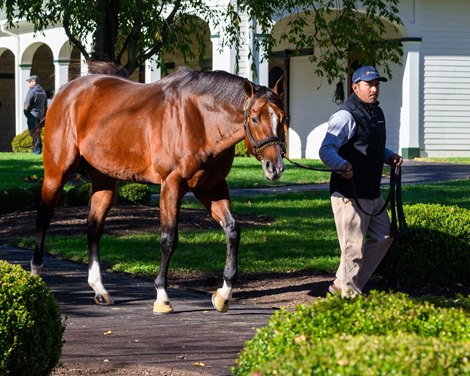
"He was a very talented racehorse," Mandella said. "There's no telling what he could have accomplished. But Wayne was just starting out with Spendthrift Farm, and he was kind of desperate to have a stallion to get things going.
"I was mad at him for doing it, and we didn't talk for a while," the trainer added. "But then when his stud fee got to be over $100,000, I told Wayne I forgave him."