

Steve Kornacki knows a thing or two about numbers. The NBC News chief data analyst, who also assists on the network's coverage of major horse racing events, said that as the sport sees the closure of tracks in major television markets, national television coverage of the sport will be more important than ever.
Some pesky numbers outline that challenge. Triple Crown races fare well in ratings but other races, even the Breeders' Cup, which faces additional challenges as it takes on college football in the fall, are not connecting as well.
Kornacki discussed this key point during an Aug. 12 presentation at the Racing and Gaming Conference at Saratoga. Kornacki noted that live racing may soon disappear from the Chicago market as the area's final track, Hawthorne Race Course, is in bankruptcy; Washington D.C., will lose out as plans call for Laurel Park to be transformed into a training center. Those changes follow racing's relatively recent exits from markets such as San Francisco-Oakland and Boston.
These changes not only result in fans not having ready access to attend live horse racing, but they also remove local media's coverage of the sport.
"These are major media markets where there's no day-to-day or even semi-regular presence of racing in the local media right now to build the support that way," Kornacki said. "I think this retrenchment of major markets—losing a day-to-day or regular presence of horse racing in these major markets—heightens the importance (of national coverage). If people in major markets aren't having access to it themselves day-to-day, or as patrons, or through local television or local media, it heightens the importance of national television (or streaming) exposure."
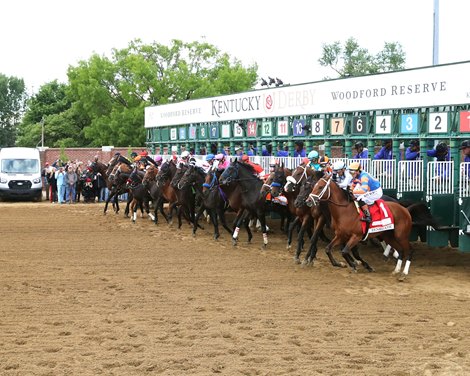
Make no mistake, the Kentucky Derby (G1) is doing very well. Kornacki presented a graphic that showed four straight years of audience growth for the Derby.
"This year's Kentucky Derby on NBC was the highest television audience, sitting right there around 20 million, since 1989," Kornacki said. "I mentioned Sunday Silence-Easy Goer. That year was the last time we saw Kentucky Derby ratings this high—37 years ago."
Kornacki noted that the core 30 minutes around the actual race saw 23 million people tune in.
"The Derby, as a television product, has been getting bigger. These are the sort of paradoxes of what we're saying in this sport right now, where there's so much retrenchment in a lot of places. The biggest event of them all, the Kentucky Derby, is quite healthy and it's getting bigger. It's caught on."
One of the things NBC is most excited about in terms of those Derby audiences is a demographic of about 50-50 men and women.
"Most sports audiences on television skew heavily male," Kornacki said. "One of the successes of the Derby and NBC has been building an event that, in some ways, transcends the sports audience and is a wider, bigger, cultural event. I think that if you watch the NBC coverage, you'll see some of that mixed in with the hardcore racing stuff that the folks like you and me like."
This year's Preakness Stakes (G1) on NBC also fared well, and Kornacki noted the potential big ratings the Belmont Stakes (G1) has enjoyed when a Triple Crown is on the line. Kornacki also showed solid numbers of about a million for the Breeders' Cup that he's always surprised aren't higher. He figures growing interest in college football has made it difficult for the Breeders' Cup to match the 4.9 million viewers it saw in its first year of 1984 as it has settled in around a million viewers for each of the past four years, peaking at 1.4 million viewers during last year's Breeders' Cup Classic (G1).
"This tells a story about the long-term trend in the sport," Kornacki said. "If you go back to the first Breeders' Cup, which was in 1984, NBC broadcast, the audience for the first Breeders' Cup was 4.9 million. There was less competition on the airwaves from college football. They were just deregulating the broadcast rights to it. Breeders' Cup beat out all but one college football game in 1984.
"In fact, if you go back and look at it, two things stand out to me. Number one, the ratings in 1984 for the original Breeders' Cup were much higher in major cities than they were in smaller markets. Horse racing was very much a sport of major cities, at least as a television product. The other thing is, when NBC got that result in that rating in 1984 of 'a mere 4.9 million for the Breeders' Cup,' the solace that they took from it, and that the industry took from it, was 'OK, it's not enormous, but it's on par with the Woodward Stakes."
For Kornacki, that's the biggest change for the sport. Races such as the Woodward Stakes (G2), Arlington Million Stakes (G1T), or the Santa Anita Handicap (G1) are a tough sell these days.
So how is national TV going to connect with race fans and potential fans at a time it's needed more than ever? On the positive side, Kornacki noted the efforts being made by the New York Racing Association and FOX Sports, saying the FOX Saratoga Saturday broadcasts on FOX have potential to resonate. The productions communicate the uniqueness of the Spa meet, the town, and the historic venue. He said it's a similar approach, focusing on stories beyond the racing, that helped grow interest in the Derby and perhaps it can grow interest in New York's key summer meeting.
"FOX is doing some stuff up here at Saratoga. I give them credit," Kornacki said. "Fox is doing these Saturdays at Saratoga. I think they produce them really well. I love how they integrate sort of the feel of the town of Saratoga and the feel of being sort of in the Backyard there at Saratoga. And they are getting some audience for that."
Kornacki imagines viewers of that show likely wanting to attend the races at Saratoga after watching those broadcasts.