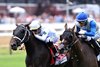


David Jerkens, the racing secretary at Del Mar, went to bed on the evening of Aug. 30 confident that his field for the $300,000 Del Mar Futurity (G1), scheduled one week hence, was holding firm at eight or nine entrants. The summer's marquee race for 2-year-olds figured to put a cherry on top of an entertaining stakes schedule that had offered horseplayers decently populated fields on both turf and dirt.
Then Aug. 31 dawned, and the Futurity fell apart like a cheap suit.
John Sadler announced that Inshallah, the pricey son of Flightline , who won a local maiden race with ease, would be pointed instead for the American Pharoah Stakes (G1) Oct. 3 at Santa Anita Park. According to Jerkens, Futurity candidates trained in Kentucky by Will Walden and Larry Rivelli were supposedly heading for California, then they were not. A few other worthy nominees from Del Mar barns faded away until, come entry time, all that remained was a field of five for the Sept. 6 contest, comprised of two runners trained by Bob Baffert and three from the barn of Doug O'Neill.
Sigh.
As a result, the Futurity has become what is likely to be just another in a series of well-paid training races for the high-priced and regally bred young guns living in the Baffert barn. Hughes is a $675,000 son of Into Mischief who won the Best Pal Stakes (G3) for fun, and the homebred Domus is a son of Uncle Mo out of a stakes-placed mare from a family of seven winning siblings. Neither colt knows yet what it's like to lose, and both sport speed figures that dwarf those of their three opponents.
Regional trainers and their horses have been known to dominate popular stakes events throughout history. Charlie Whittingham won the San Juan Capistrano Handicap (G1T) 14 times with 14 different horses over a 32-year span. D. Wayne Lukas racked up eight wins in the Hopeful Stakes (G1) between 1990 and 2017. And if anyone is going to top Todd Pletcher's eight wins in the Coaching Club American Oaks (G1) and the Florida Derby (G1) they'd better get going, because he's not through yet.
Even so, such numbers are dwarfed by the tidal wave of 2-year-olds trained by Baffert to win the West's best prizes over the past three decades. As the fortunes of California racing ebb and flow and mostly ebb, his dominance has been the single constant, for better or worse. And the Del Mar Futurity—among the nation's oldest, most respected races for the division—provides the most dramatic evidence.
Winners such as Your Host (1949), Old Pueblo (1957), and Tomy Lee (1958) gave the Futurity occasional cache in its youth. Later, as Del Mar Futurity winners began aging well to take other major prizes, the race gained national note. For a broad swath of owners and trainers, the Futurity was a trophy worth the trouble.
The 31 winners of the Del Mar Futurity between 1966 and 1995 were trained by 28 individuals. (The 1971 version, during a brief run on grass, was split into divisions.) Lukas won the race three times in that period and Ron McAnally twice. The 1977 Futurity was credited to Loren Rettele even though Mary Lou Tuck was the real trainer, but she couldn't get a stall.
In contrast, the 30 winners of the Del Mar Futurity between 1996 and 2025 were trained by 10 individuals. Richard Mandella and Doug O'Neill each won the race twice. Jerry Hollendorfer, Dave Hofmans, Peter Miller, Ron Ellis, Luis Mendez, Mick Ruis Sr., and Kathy Walsh accounted for one apiece.
Bob Baffert won 19.

If you are a Bob Baffert client, this has been a good thing. Those 19 winners have represented 14 different ownership groups. Champions American Pharoah, Game Winner, Lookin At Lucky, Midshipman , and Silver Charm have been among them. The Futurity also has produced champions Declan's Moon, Stevie Wonderboy, and Nyquist trained by others during the Baffert era, but they have been the exceptions to a rule that by now seems unshakable.
Unless a sports fan has grown up steeped in the tradition of teams such as the Celtics or the Yankees, dynasties can be a drag. Variety is the spice of professional athletics.
"Don't try to strike everybody out," scolds catcher Crash Davis in "Bull Durham," berating a hotshot young pitcher. "Strikeouts are boring. Besides that, they're fascist. Throw some ground balls—it's more democratic."
The Del Mar racing office attempted to rearrange the deck chairs of the Futurity's sinking reputation this summer by offering a slate of "auction" races that protected promising 2-year-olds from the million-dollar babies of the Baffert shed row.
"The idea was to create winners from other barns, and we did have a number of trainers with nice 2-year-olds who broke their maidens other than Bob," Jerkens said. "We were hoping to get some of them for the Futurity, but it just didn't work out."
Jerkens did manage to lure 10 fillies this weekend for the Del Mar Debutante Stakes (G1) on dirt and nine for the listed Del Mar Juvenile Fillies Turf Stakes at 1 mile, while a group of nine will go in the Del Mar Juvenile Turf Stakes (G3T), also at a mile (the latter originally had 10 entered, but Dang Son has since been scratched to run in the Futurity). Of those 28, Baffert trains only three, indicating that there are patrons spending serious money on young horses who send them to a variety of trainers for racing out West, where weather and surfaces are fairly consistent.
One of those patrons is Eclipse Thoroughbred Partners, led by president Aron Wellman.
"A five-horse Futurity field with horses from just two trainers is an indictment of California racing," Wellman said. "Something needs to be done, because California is important to the health of the industry as a whole. Certainly, we're irritated we don't have one ready for the Del Mar Futurity, but ours will be a little later developing this time around."

At least there are alternatives. Along with other partners, Eclipse will be represented by two runners—maiden winners Itinerary and Observed—in the Del Mar Juvenile Turf.
"When we buy well-bred colts as yearlings, the main criteria we've got to check off is their potential to run a route of ground," Wellman said. "Then we'll find out what surface they're good on. I wouldn't say turf is option A, although the turf program for young horses has become very lucrative. More than the turf, these Del Mar races offer a chance to go beyond a sprint. Whether turf remains their future remains to be seen.
"In the end, I don't discriminate," Wellman added. "I don't care what a horse is good at, as long as they're good at something."