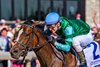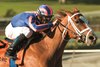


The proximity of the dates were coincidental, but the symbolism rang true, embracing the yin and yang of the Thoroughbred racing universe. Zippy Chippy, a name synonymous with failure on the racetrack, died on April 15, five days shy of turning a full 31, while Cigar, a horse who epitomized the thrill of victory, would have turned 32 on Monday, April 18. Cigar died in 2014.
Zippy Chippy lost each and every one of the 100 races in which he competed over a span of 11 seasons, 1994-2005. Cigar reigned as North American Horse of the Year in 1995 and 1996 and at one point reeled off 16 consecutive wins, which included victories in the Breeders' Cup Classic (G1) and the inaugural running of the Dubai World Cup (G1).
Their paths crossed once, sort of. At Aqueduct Racetack on Oct. 28, 1994, Zippy Chippy, making his ninth start, finished ninth of 12 in a 1 1/8-mile event for straight maidens on the grass. He was undoubtedly home and dry back in Carl Domino's barn by the time Cigar came over for the sixth race at a mile on the dirt, which he promptly won by eight lengths to commence his 16-race streak.
Cigar was infertile at stud and subsequently retired to the Kentucky Horse Park in 1999, where he reigned alongside fellow two-time Horse of the Year John Henry. Zippy Chippy ran for the last time on Sept. 10, 2004, finishing last in a race at the Northampton Fair in Massachusetts. Six years later, Zippy Chippy was purchased for $5,000 by Old Friends Equine in Kentucky.
"He's the only horse we ever bought," said Michael Blowen, president and founder of the Eclipse Award-winning Old Friends operation that has been a retirement haven for nearly 300 former racehorses. "His owner, Felix Monserrate, wanted $15,000. And he wanted to make sure he retained the rights to a movie Disney supposedly wanted to make of the horse. There were lawyers involved."

Since Zippy Chippy earned a tad less than $31,000 during his racing career, it makes sense Monserrate, who died in 2015, would want to squeeze every nickel he could out of the son of Compliance. In fact, there was considerable incentive for Zippy Chippy to run up his losing streak to a nice, neat 100 races, obsessed as the culture is to finely rounded numbers. This would explain why his owner, who also trained the horse, continued to race Zippy Chippy after the old boy dwelt in the starting stalls in a number of races, or bolted on first turns, or spit the bit halfway through. When no other track would allow Zippy Chippy to compete—for his own good as well as the pari-mutuel welfare of their customers—Monserrate shopped around and found a willing management at the Northampton Fair.
By then, Zippy Chippy and his string of losses had been featured on various television networks and in a file drawer full of articles. To the outside world, the idea that a horse could run so often and continue to whiff was amusingly inspiring. He became a four-legged Rudy of football fame, an equine version of ski jumper Eddie the Eagle. And, in fairness to Zippy Chippy, he did finish second eight times.
The first of those seconds came in his 28th start on Sept. 23, 1995, at Finger Lakes in upstate New York. He was beaten 1 1/4 lengths by Ginger's Appeal, who never won another race. Zippy Chippy wheeled back 10 days later for another second-place finish, this time by a neck to Boardwalk Runner, who ran only seven times.
If nothing else, Zippy could stand the gaff. Monserrate ran him three more times that October and four times in November before his horse was second again. In 1996, Zippy Chippy ran 14 times before he declared "no mas" in start 15 and was eased in the stretch.
On and on it went. There were 20 starts in 1997 with only a single runner-up check, followed by two seconds in 13 starts in 1998, one of which was 22 1/2 lengths behind the winner. Some fans thought this was heartwarming, which only proves that some hearts warm more easily than others.
Zippy Chippy ran once in 1999 in order, apparently, to lose what was thought to be a record 86th race. As it turned out, it wasn't. Okay then. Let's bring him back for a handful of races at 9, 10, 11, 12, and 13 to see if he can lose 100. In the meantime, Zippy's owner was tossing his horse into exhibitions against harness horses and minor league ballplayers, and vanning him around to open shopping malls.

At some point in the Zippy Chippy odyssey, Michael Blowen became an ardent follower. In 2003, Blowen founded Old Friends Equine as a final retirement home for geldings, pensioned stallions, and mares at the end of their productive careers. The idea was to attract marquee names with a built-in fan base, as well as blue-collar runners who raced under the radar. Zippy Chippy, a horse who clearly needed to be retired, seemed a viable candidate to help jumpstart the Old Friends program.
Then came the first race on the afternoon of Sept. 6, 2003, at Northampton. The Saturday crowd made 12-year-old Zippy Chippy and his 0-for-98 record 7-to-1 in a maiden special weight event at 5 furlongs for a purse was $3,100. Blowen was there.
"He ran a good race and finished second," said Blowen, a native New Englander and former film critic for the Boston Globe. "Then the inquiry sign went up flashing the winner. I saw Felix climb up the stewards stand, which looked like one of those guard towers in a Nazi war movie. He was screaming, 'No, no. He can't win like this!' Everything about Zippy's life was backwards."
The result stood and the streak continued, then ended one year later with two more losses at the fair. In addition to the movie rights—which apparently went to that place where all movie rights go to die—there have been two books written about Zippy Chippy, including one titled, "The Legend of Zippy Chippy: Life Lessons from Horse Racing's Most Lovable Loser."
I'm not sure what lessons he conveyed. The horse merely was doing what he was told to do, and the consequences were that he had to keep doing it until an artificial goal had been reached. He wasn't that lovable either, as Blowen notes, but he did love his life at the Old Friends Bobby Frankel division at Cabin Creek, near Saratoga Springs. N.Y., where he was cared for by farm manager JoAnn Pepper. Clearly, the last half of his life was better than the first.
"He was supported throughout his life by his fans," Blowen said. "And he earned far more for the farm and his fellow retirees than he ever did as a racehorse."