


On April 4 at Santa Anita Park, two hours before post time for the Santa Anita Derby (G1), one of seven 3-year-old fillies will try to place her name alongside the likes of Beholder, Songbird, Stellar Wind, Rags to Riches, Midnight Bisou, and Serena's Song as the winner of the Santa Anita Oaks (G2).
At a mile and one-sixteenth on the main track, the local Oaks has been a reliable benchmark for success—or at least a noble effort—in the Kentucky Oaks (G1) run a month later at Churchill Downs. The two Oaks have been run in lockstep since 1937, except for the three years Santa Anita was closed in service to the effort required to fight World War II (spoiler alert—we won that one).
The first filly to bag both Oaks was Blue Norther, the pride of Fritz Hawn, who won twice at Keeneland between dates in California and Kentucky in 1964. Since then, Susan's Girl, Bold 'n Determined, Blush With Pride, Fran's Valentine, Lite Light, and Rags to Riches have won both titles. And even though it's been 19 years since a filly has completed the parlay, Santa Anita Oaks winners Beholder and Swiss Skydiver were second in Kentucky, while Midnight Bisou and Desert Dawn finished third.
Enough history, other than to point out the race used to be called the Santa Susana Stakes, named for a town in rural Simi Valley, north of Los Angeles. Santa Susana was famously home to the Corriganville Movie Ranch, where just about every Western of this boy's childhood was filmed.
In 1986, Santa Anita management surrendered to a bad case of Oaks envy and renamed the race. This was understandable, since by then the branding had become ubiquitous. There was a Michigan Oaks, a British Columbia Oaks, an Illinois Oaks, and a Queen City Oaks, not to mention a California, Del Mar, and Hollywood Oaks right in their own backyard.
Like the Kentucky Oaks, the Santa Susana was designated a grade 2 race from the debut of the graded stakes list in 1973. The race ascended to grade 1 status in 1979 and remained that way through 41 runnings until its downgrade in 2020. This, despite the fact that its seven previous winners included four champions and another that went on to be grade 1 winner.
Members of the American Graded Stakes Committee will explain to us—innocent children that we are—that the grade of a race is based on, among other subjective factors, the performance of horses in other graded races. We children stare back, mouths agape, wondering, "But isn't that an example of a circular reference fallacy, defined as an argument that 'assumes its own conclusion as its premise?'"
That may be nitpicking, but the steady downgrading of Southern California stakes races over the last decade is beginning to take its toll. The Thoroughbred Owners of California has taken advantage of the situation to fund stakes at the bare minimum to qualify for their grades, removing all incentive for horses to either ship west for traditional events or even for local horses to stay put.
At $200,000, the Santa Anita Oaks purse is humiliated by the $1 million Fantasy Stakes (G2) at Oaklawn Park, the $750,000 Ashland Stakes (G1) at Keeneland, and even the $400,000 Fair Grounds Oaks (G2) in New Orleans. At Santa Anita, the Las Virgenes Stakes, once upon a time a grade 1 event for 3-year-old fillies, has fallen to listed status in spite of its key position as a two-turn test on the early road to the Kentucky Oaks.
Meaning, a daughter of Gun Runner owned by Bridlewood Farm and Eclipse Thoroughbred Partners and trained by Michael McCarthy, won the Las Virgenes in her last appearance Feb. 8, just the third start of her career. Prior to that, she won a Sept. 20 maiden sprint at Los Alamitos Race Course and then finished a promising fourth in the Breeders' Cup Juvenile Fillies (G1), coming on late after encountering trouble on the final bend.
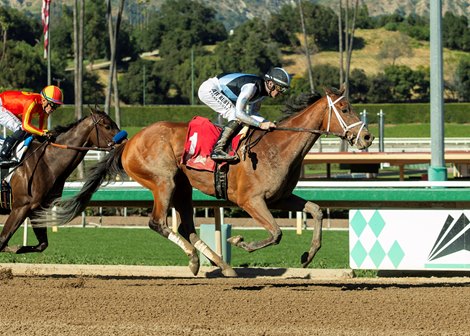
In order to become a listed stakes winner, Meaning had to beat the 1-2 finishers in the Juvenile Fillies, Super Corredora and Explora. That alone seems enough to explain her 3-5 morning-line odds for the Santa Anita Oaks, even though her opposition Saturday is led by the 1-2-3 finishers in the Santa Ysabel Stakes (G3) from one month ago.
"We've always looked at Meaning as a Kentucky Oaks prospect," said Aron Wellman, president and founder of Eclipse Thoroughbreds. "She's always inspired a lot of confidence, but we didn't want to over-race her going into what we hope is an opportunity to run in Kentucky."
Speed figure followers will notice that none of the Santa Anita Oaks entrants have knocked the socks off the clock. Their career tops in Beyer numbers are all clustered in the high 70s and low 80s.
"I'm a guy who usually trusts his instincts, along with those of a trainer like Michael McCarthy," Wellman said. "We do consult with the figures from a secondary source point of view to make sure we're not being too aggressive in terms of race spacing, where a horse might have run faster or harder than we've gauged it to be."
Of more concern is the tightrope walked by West Coast owners and trainers who need to earn from a limited reserve of participation points in order to make the gate for the Kentucky Oaks. There are only 14 stalls available.
To its credit, Churchill Downs management has recognized the regional imbalance and awarded Kentucky Oaks qualifying points to all four open 3-year-old filly stakes at Santa Anita, even though the Santa Ynez Stakes and Las Virgenes are merely listed events.
That's fine, as far as it goes. But Wellman is among a growing number of owners and breeders who see no justification for the incestuous relationship between purses and grades, especially when it comes to traditionally respected races for fillies.
"The dollars themselves are important," Wellman said. "Of equal importance, though, is the prestige and the graded caliber designation of those races for fillies. It's a sad state of affairs for so many important races in Southern California to be downgraded, and the Santa Anita Oaks is a prime example."
The Oaks is the only grade 2 race for 3-year-old fillies on the dirt in California. There are no grade 1 routes; the only main track grade 1 for sophomore fillies is the 7-furlong La Brea Stakes (G1) in December.
"I think it's a very dangerous trend that's been in process for several years now, especially when it comes to fillies," Wellman said. "The backbone of our industry is the fillies who ultimately become broodmares. Their residual value to consistently churn revenue into owner's pockets so they can put it back in the game is extremely vital."
The Eclipse interests are led by classic winner Journalism, who is nearing a return to the races at age 4. In years past, that return could have been in a mid-May race like the recently eliminated Californian Stakes (G3), once funded with a purse of half a million dollars.
"The quality of California racing keeps taking one beating after another," Wellman said. "There needs to be some incentive to race in important jurisdictions, like Florida and California, that aren't able to compete right now with the subsidies boosting purses elsewhere.
"Competing against Bob Baffert is not ideal," added Wellman, who will be facing two from the all-powerful Baffert barn with Meaning. "But we need to give people a reason to want to do that, and that's either in purses or making sure the graded status of these races is preserved. Otherwise the decline will lead to inevitable collapse."
No question, the downward spiral of graded races and attendant purses in California will continue unless the obvious alarms are answered. Wellman is among a growing cohort calling for a commitment to maintain Thoroughbred racing as a truly national enterprise.
"The industry is sitting on a lot of capital that supposedly has been set aside for a rainy day," Wellman said. "The saying goes, 'It never rains in Southern California.' But for anyone paying attention, it's pouring outside."