


As Thoroughbred racing heads into a new year, it faces the inevitable challenge of learning from the past 12 months and applying those lessons to a new year.
With 2026 at hand, BloodHorse has reprised its online year-end survey to ask some of the sport's leading individuals for their opinions on pertinent issues facing the sport.
Through Jan. 2 in the BloodHorse Daily and on www.bloodhorse.com, a select group of panelists will address issues such as the most exciting freshman sire for 2026, field size, what participants tell newcomers they like most about the sport, foal crop size, the Breeders' Cup, and the Triple Crown. We continue the series with a question about gambling.
While realizing there are countless other voices, the hope is that these answers will spark meaningful discussion within the industry.
Anyone who would like to offer their opinion is encouraged to submit it in writing to editorial@bloodhorse.com for inclusion in our Letters to the Editor. Longer pieces can be considered for an Industry Voices column.
To access our 2023 year-end survey, please click the following link for a pdf version.
Responses were edited for style and clarity.
Question: One way people come to racing is through the gambling side. Should racing embrace fixed-odds wagering? Is racing doing enough to bring over customers from the growing sports-betting market?
Dennis Drazin, chairman and CEO of Darby Development, which operates Monmouth Park: Fixed-odds wagering should be embraced by the horse racing industry because it represents an opportunity to grow our handle and help embrace a crossover from traditional sports bettors.
Especially in these times where the customers are concerned about computer-assisted wagering, fixed odds represent a solution to offer our customers.
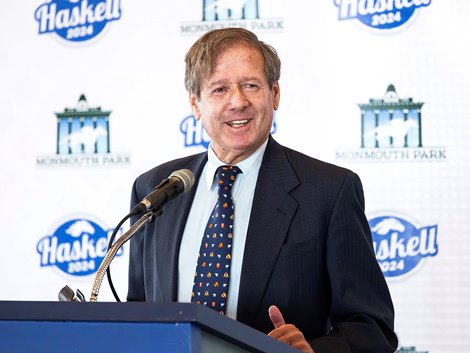
One of the biggest complaints I get from the betting public is the big change of odds at the last second and the substantial change of odds after the horses break from the gate while the pools are bombarded with CAW volume. Fixed odds offer the gambling customer an opportunity to lock in their odds at the time they wager regardless of the odds fluctuation while the horses are breaking from the gate.
Unfortunately, fixed odds will only succeed when the major racetracks embrace fixed odds and permit their signal to be wagered upon.
When fixed odds launched at Monmouth Park there were parlay wagers on Haskell day enabling a bettor to combine three legs of stakes races coupled with a baseball game. We found that many traditional sports bettors experimented with the combined wagers and continued to bet on horse racing afterwards.
We need to find ways to attract the traditional sports-betting gambler to bet on horse racing.
Now that it's commonplace for gamblers to bet sports on their apps and retail venues and the demographics are attracting younger bettors (over 21), we need to add horse racing opportunities to our customers' wagering options particularly since the content on international horse racing far exceeds opportunities to bet other sports (i.e. 30,000 horse races 24/7 vs. limited seasons and games for NFL, NBA, NHL, MLB, and NCAA football, to name a few).
If horse racing could even capture the same amount of wagers as sports like tennis, our market share would grow immensely.
In Australia, fixed odds grew their handle on horse racing immensely. Their population is 10% of the United States population but their handle exceeds ours by more than double.
We must do a better job of offering our gamblers more options in order to grow our sport.
Dave O'Rourke, CEO and president of the New York Racing Association: NYRA has absolutely embraced fixed-odds wagering. The rapid expansion of sports betting means that huge numbers of bettors are wagering on a fixed-odds product and may not be comfortable or familiar with the pari-mutuel marketplace. Current New York State law does not allow for horse racing to be offered with fixed odds. In addition, we are not allowed to accept fixed-odds wagers on our content from bettors in other states.
We have been very active in Albany for multiple legislative sessions to help advance legislation that would allow horse racing to sit on the sports betting shelf next to every other professional sport.
We don't necessarily view fixed odds as a significant generator of handle in the near term. It is, however, a huge marketing opportunity to gain access to an entirely new generation of people for whom sports betting is a source of entertainment.
Allowing horse racing to be offered on sports-betting platforms would generate important tax revenue for New York State and create interest in horse racing. That's what we will continue to emphasize in the upcoming legislative session. We are optimistic that we will get there.
Nick Tammaro, track announcer and handicapper at Sam Houston Race Park and player development manager at Sam Houston and Retama Park: I'd love to have a limited fixed-odds offering, but there are barriers to implementing such that have to be navigated.
Making sure players aren't shut out when they're winning too much or too often is a major concern. As is ensuring the proper liquidity in those markets to make them appealing. Would I like to be able to hand a parlay card to everyone that walks through the door at Sam Houston Race Park and encourage them to choose how many "legs" there are and get them handicapping the card to play? Sure. We can ensure the props on that card are a little easier to comprehend for a newcomer.
The biggest challenge we face with attracting new bettors, including those more accustomed to sports wagering, is to get them to sign off on regularly receiving a price that alters from what they think they're getting. We are not doing enough to bring sports bettors over because we have a product that is improperly priced and inconsistent from an odds standpoint.
Serious consideration needs to be given to reducing takeout in high-churn pools such as win, place, show, and exactas rather than solely larger, horizontal wagers that tie up money for multiple hours. Being told a wager is "retail only" is nice, but a 1% takeout drop in vertical pools has a much larger long-term impact.
We also must have more price stability, which will require additional efforts to ensure people are getting close to the price that they think they're getting when the field leaves the gate.
Adam Wachtel, owner/breeder who spends much of his time using Ragozin Sheets to handicap and identify potential racehorse purchases: I believe the expansion of fixed-odds wagering into the many markets that currently don't offer it could be an excellent way to attract new bettors into the Thoroughbred betting market. Having said that, I'm unclear as to what the data shows in markets like New Jersey that have legalized such wagering. My assumption is that it's been very positive.

We all know the sports-betting market has exploded in recent years. The next generation of sports bettors has really taken to the clever betting products that are currently in the marketplace for so many sports.
Fixed-odds wagering for horse racing seems like a logical next step to help attract some of these customers. I guess many of us have had a taste of this in betting Kentucky Derby (G1) futures.
This year, I had a futures bet on Baeza that I placed after his debut. So, when he made it to the Derby with a chance, it definitely played a role in my betting approach to the Derby. A possible hedge opportunity was created. I think this would hold true in day-to-day wagering.
And, I believe this would appeal to bettors that have either just started to take a look at wagering on horse races or are just starting to consider it. Basically, any sensible approach to offering the public new and creative ways to wager on our sport can certainly be a big positive.
Judy Wagner, National Horseplayers Championship winner and Hall of Fame member: Horse racing, a love of mine, is floundering. Fixed odds have been puzzling to me. Initially I was mildly opposed because of my personal betting patterns/strategy. This because I am a serious handicapper but a small bettor.
But the CAWs are so strong now it is something that turns a 6-1 bet into often times 2-1 or less. When wagering, if I had known prior to my wager I was getting 2-1 as opposed to 6-1, I probably I would not have wagered.
Although a small bettor, is it more important to get my wagering dollars or cater to the CAW? Of course, they are putting far more dollars through the windows, offshore, or wherever they are. But are we trying to attract the younger crowd, new players or strengthen our industry? I am baffled.
If fixed odds are what it takes to level the playing field for players, then I am leaning toward fixed odds.
As a small player I want to see the pari-mutuel pools be on a level playing field, but personally I feel that ship has sailed unless the tracks can come together and agree to closing pools at a set time before horses go into the gate.
Horse racing must find a way to remove any doubt of issues of integrity. There are so many avenues for wagering on sports, horse racing must stop fighting and band together to promote a strong product that can be marketed to young, new, and longtime loyal patrons.


