

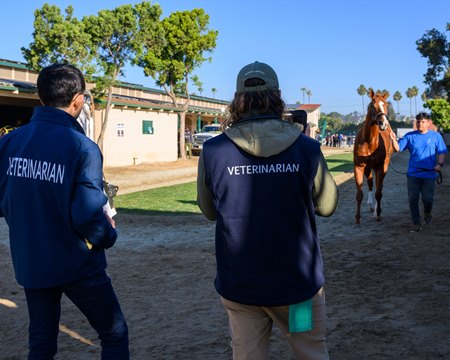
Some recently collected numbers by BloodHorse suggest regulatory vets are making many correct prerace decisions in their highly scrutinized positions as final protectors of the horse before a race.
It's always a tough call as every horse entry represents some level of investment by the owner and the horse's connections. Sometimes that investment is quite significant, such as stakes races that require travel.
On the other side of the coin is protecting the horse, and along with that, the public standing of horse racing. The recently collected data point to horses that are scratched by regulatory vets frequently receiving extended layoffs following such decisions. While every case has its own story, it's safe to say that, most of the time, if a horse scratched by a regulatory vet then receives an extended layoff, that removal from the race likely protected a vulnerable horse.
Thanks to some state jurisdictions providing additional transparency on scratches in recent years, it's now possible to isolate such regulatory vet calls. Jurisdictions including Delaware, Kentucky, and New York note when regulatory vets make the call to scratch a horse from a race.
BloodHorse requested and received this information from The Jockey Club. We then looked at these types of scratches over the time frame of July 1, 2024-June 30, 2025. In that year's time examined, there were 13,868 vet scratches—private or regulatory vet.
From the three states that provide further detail, we find that they listed 947 of these instances as regulatory vet scratches. This is the group we will look at: scratches listed as regulatory vet scratches during this one-year period of time. In looking at this group, 233 of those 947 horses scratched by regulatory vets have not returned to the races. That is 25% of the horses scratched by regulatory vets in the year's time ending June 30 have not returned to make a single start (through Dec. 11, 2025, when we wrapped up this study).
Of the 947 horses scratched by regulatory vets, the average time away before a race for those horses was 135 days. (For scratched horses who had not again started through Dec. 11, this average counts the days from their scratch date through Dec. 11.)
Besides designating when regulatory vets are making the decision to have a horse scratched, some states provide further detail, with "unsound" being one of the reasons listed for vet scratches. When this category filter is added, it returns 586 horses for the one-year period examined. Of this group, where unsoundness is specifically noted, 168 (29%) did not return to racing by Dec. 11.
In October, California Horse Racing Board equine medical director Dr. Jeff Blea pointed to similar in-state numbers that suggest regulatory vets in the Golden State are providing important protections. He delivered the highlights of a comprehensive analysis of scratches in California, as well as voided claims for post-race unsoundness.
There were 23 horses scratched in the post parade in the most recent full fiscal year in California. Of those horses, it took them an average of 108 days to return to the races. It took their cohorts an average of 39 days. Comparing the two groups, we see that it took the scratched horses nearly three times as long to return.
Speaking ahead of the 2025 Breeders' Cup World Championships, CHRB executive director Scott Chaney applauded the record of regulatory vets in the state, noting that instead of praise, they often are criticized by connections.
"My counterparts in other states are (also) dealing with pushback from owners and trainers, in which challenging the reg vets has become an epidemic," Chaney said. "I'll say this, one: Regulatory vets are increasingly difficult to find. In large part, this is due to the difficult conditions in which they have to work. And two: Such criticism is most entirely unhelpful and more importantly, inaccurate."
To make that case, Chaney provided further detail on in-state vet scratches.
"Of the 803 claims in California last fiscal year, 109, or 13%, were voided post-race. Of those 109, nearly half have failed to return to the races, and the other half took an average of 148 days to return to racing, compared with the 28 days it took 95% of their cohorts to return to racing.
"This is all to say that regulatory veterinarians are exceedingly accurate at identifying at-risk horses," Chaney added. "Will an otherwise sound horse be scratched on occasion? Absolutely. However, the statistics demonstrate that this is exceedingly rare, and I am certain that it is entirely worth it when compared to the risk and cost to the horse racing industry if a questionable horse is permitted to run, much less suffers a catastrophic injury."
Of course, an owner or a connection of one of those sound horses that is occasionally scratched will have a much different view. But the numbers suggest at-risk horses are being protected by this final line of defense. Perhaps more improvements can be made so that healthy horses are not scratched. For now, Chaney called for more perspective.
"Make no mistake, the scratch of a Breeders' Cup entrant is heartbreaking for the connections and fans," he said ahead of the most recent World Championships, "but criticism of the regulatory vets is misplaced and ultimately does damage to the promotion of animal welfare and the image of horse racing generally."


