
The dark cloud that hung over the 2025 Breeders' Cup Juvenile (G1) continues to loom. Ted Noffey, the winner and subsequent champion of the division, has now joined runner-up Mr. A. P. on the sidelines. This unfortunate development keeps intact the nearly flawless record of consistency when it comes to Juvenile winners going on to glory in the Kentucky Derby (G1). In 42 years, there have been only two. Name them for a nickel.
Thanks to a pair of veterinary scratches from the original eight entered, the '25 Juvenile field was the smallest in the history of the race. To be perfectly fair, the foal crop from which the field sprang was around 17,200, compared with the 1982 crop of 42,894 that fed the first running of the Juvenile in 1984. But who said anything about being fair? This is a time for indignant outrage.
Among the others in the Juvenile, third-place finisher Brant has had only two easy works since the race, and his first start as a 3-year-old is yet to be determined. Brant's Bob Baffert stablemate Litmus Test finished fourth in the Breeders' Cup Juvenile then wheeled right back to take the Los Alamitos Futurity (G2) in December. Litmus Test was entered to run Jan. 31 in the Southwest Stakes (G3) at Oaklawn Park. That date was lost to weather, though, and the race is now scheduled for Feb. 6.
The two colts scratched from the Juvenile, Civil Liberty and Blackout Time, took the rest of 2025 off. Both returned to the workout tab in January—Blackout Time with Kenny McPeek at Fair Grounds Race Course & Slots and Civil Liberty with Doug O'Neill at Santa Anita Park. Blackout Time finished second to Ted Noffey in the Breeders' Futurity (G1) at Keeneland, while Civil Liberty, still a maiden, was third in the Del Mar Futurity (G1) and fourth in the American Pharoah Stakes (G1).
"He's still got that maiden condition, so he'll probably be ready for that kind of race in 30 days or so," reported O'Neill.
Comport, winner of the 2025 Ellis Park Juvenile Stakes, was sixth in the Juvenile and has not worked since. That leaves Intrepido, hero of the American Pharoah but fifth in the Juvenile. A poor start cost the son of Maximus Mischief that day.
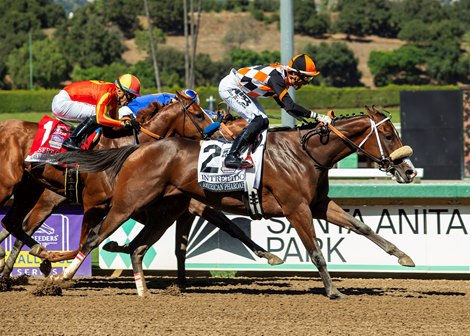
"I guess he got restless in the gate," said Intrepido's trainer, Jeff Mullins. "They grabbed his ear and he got mad, then when the gate opened he jumped in the air and lost all chance. You had to be on or near the lead that day, so he lost all chance."
Intrepido is a racy bay ridgling who unleashed a powerful stretch kick to collar the Baffert colts Desert Gate and Plutarch in the American Pharoah. Mullins was asked if his horse has changed much going from 2 to 3.
"A little bit," the trainer replied. "I just hope he hasn't lost that edge he had when he won the stake at Santa Anita, but you never know till you try. I took it easy on him for two or three weeks after the Breeders' Cup, then went right on with him. I knew I had plenty of time."
And now the time has come. Intrepido had five works in December and three more this month, including a fiery :59 2/5 five-eighths from the gate at Santa Anita Jan. 24. One more breeze and he'll be set for the Robert B. Lewis Stakes (G3) Feb. 7. The 1-mile event has drawn 11 nominees—five trained by Baffert—as well as recent Santa Anita stakes winners So Happy and Start the Ride.
The Lewis is the first California race of the year offering starting berth points for the Kentucky Derby. A total of 42 points spread across the first five finishers is at stake.
After the Lewis, there will be two more points races for males at Santa Anita, including the Santa Anita Derby (G1) in the final round of "championship" events. The local Derby will need to field at least six starters or risk losing 25% of its points. Churchill Downs officials claim that the minimum field size requirement encourages racetracks to nurture a larger inventory. In government circles, this is known as an unfunded mandate.
Forward Gal Remembered at Gulfstream
The Jan. 31 card at Gulfstream Park features races honoring Holy Bull and Swale, two of the most exciting colts of the late 20th century. But how about the other feature on the program, the Forward Gal Stakes (G3) for 3-year-old fillies at 7 furlongs?
Forward Gal was the 2-year-old filly champion of 1970, the year before the Eclipse Awards were inaugurated to unite the various season-ending polls. The chestnut daughter of Native Charger easily was the consensus choice, based on a record of seven wins in 13 starts over a campaign that began in March and ended in November. It's tiring just typing those words, let alone imagining a modern 2-year-old standing such a gaff.
Charles Hatton, in his American Racing Manual review of the 1970 season, described the earliest version of Forward Gal as "growthy and immature and perhaps not frightfully smart." Witnessing her victories in the Sorority Stakes at Monmouth Park, the Spinaway Stakes at Saratoga Race Course, and the Frizette Stakes at Belmont Park brought Hatton around, though, to hold her up as "a long-stemmed flower who may prove a hardy animal."
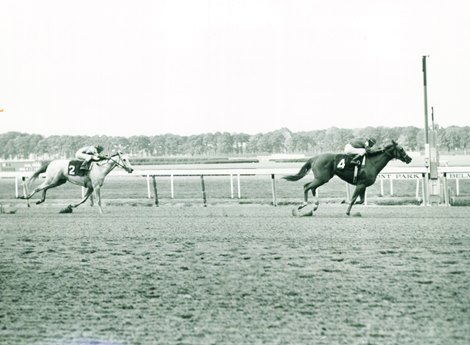
Racing for breeder Butch Savin and trainer Jimmy Croll, Forward Gal proved Hatton right with 13 more starts at age 3. She won the Comely Stakes, the Monmouth Oaks, and the Gazelle Handicap, while hitting the board in half a dozen other major events. Even with her exemplary record, Forward Gal never made it to the Hall of Fame, so a good race on a big day is the least her memory deserves.