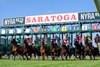

Some of the best 3-year-old Thoroughbreds in the country will battle in one of the marquee stakes in the division when they face off in the $1 million Haskell Stakes (G1) July 18 at Monmouth Park.
The expected field for the 1 1/8-mile race includes Napoleon Solo and Iron Honor, the top-two finishers from the Preakness Stakes (G1); Blue Grass Stakes (G1) winner Further Ado; The Puma, winner of the Tampa Bay Derby (G3); and Ocelli, the third-place finisher from the Kentucky Derby (G1).
Analyzing the history of the Haskell—the results over the past 20-plus years—reveals half a dozen recurring trends, which can be used to sort through the 2026 Haskell contenders and identify the most likely winner.
Keep the following six trends in mind when handicapping this year's Haskell:
early speed useful
You don't want to drop too far off the early pace in the Haskell. History reveals 15 of the past 21 winners (71%) were racing within 2 1/2 lengths of the lead after the opening half-mile.
|
Year |
Winner |
Position after first 1/2-mile |
1/2-mile & 3/4-mile |
|
2025 |
Journalism |
7th by 6.25 lengths (8 starters) |
:46.83, 1:10.75 (fast) |
|
2024 |
Dornoch |
1st by 0.5 lengths (7 starters) |
:48.08, 1:12.05 (fast) |
|
2023 |
Geaux Rocket Ride |
4th by 2 lengths (8 starters) |
:47.11, 1:11.65 (fast) |
|
2022 |
Cyberknife |
6th by 4.5 lengths (8 starters) |
:46.96, 1:09.93 (fast) |
|
2021 |
Mandaloun |
4th by 2.5 lengths (7 starters) |
:47.32, 1:10.64 (fast) |
|
2020 |
Authentic |
1st by 1 length (7 starters) |
:47.52, 1:11.50 (fast) |
|
2019 |
Maximum Security |
3rd by 0.5 lengths (6 starters) |
:46.71, 1:10.17 (fast) |
|
2018 |
Good Magic |
2nd by 2.5 lengths (7 starters) |
:46.83, 1:11.48 (fast) |
|
2017 |
Girvin |
7th by 9.25 lengths (7 starters) |
:47.34, 1:11.25 (fast) |
|
2016 |
Exaggerator |
6th by 4.75 lengths (6 starters) |
:46.62, 1:11.00 (sloppy) |
|
2015 |
American Pharoah |
2nd by 1 length (7 starters) |
:46.14, 1:09.60 (fast) |
|
2014 |
Bayern |
1st by 0.5 lengths (9 starters) |
:47.66, 1:11.16 (fast) |
|
2013 |
Verrazano |
2nd by 0.5 lengths (7 starters) |
:48.22, 1:12.43 (fast) |
|
2012 |
Paynter |
3rd by 0.5 lengths (6 starters) |
:48.01, 1:11.37 (fast) |
|
2011 |
Coil |
8th by 5.5 lengths (8 starters) |
:47.02, 1:10.68 (fast) |
|
2010 |
Lookin At Lucky |
4th by 2 lengths (7 starters) |
:47.95, 1:12.51 (fast) |
|
2009 |
Rachel Alexandra |
2nd by 0.5 lengths (7 starters) |
:46.43, 1:09.92 (sloppy) |
|
2008 |
Big Brown |
2nd by 1.5 lengths (7 starters) |
:46.59, 1:10.85 (fast) |
|
2007 |
Any Given Saturday |
3rd by 2.5 lengths (7 starters) |
:47.11, 1:10.70 (fast) |
|
2006 |
Bluegrass Cat |
3rd by 4 lengths (9 starters) |
:47.52, 1:11.85 (fast) |
|
2005 |
Roman Ruler |
4th by 1.25 lengths (7 starters) |
:47.72, 1:11.69 (fast) |
Triple Crown alums have advantage
Alumni from the Triple Crown—the Kentucky Derby, Preakness Stakes, and Belmont Stakes (G1)—perform best in the Haskell. Horses who contested one or more legs of the Triple Crown have won 30 of the past 35 editions of the Haskell (86%).
Proven routers ones to bet
Horses who have yet to win a race over a route distance (one mile or farther) are winless in the Haskell since at least 1981, as far back as we have researched.
Bet established stakes winners
Forty-six of the past 47 Haskell winners (98%) had previously won a stakes race. The only exception was Paytner in 2012, and he was exiting a runner-up finish in the Belmont.
Favorites, short-priced runners tough
The betting favorite is typically formidable in the Haskell. Favorites have won 12 of the past 21 editions (57%), far exceeding the typical win rate for favorites. Furthermore, only three Haskell winners since 1992 have started at odds of 5-1 or higher, and 55 of the past 63 top-three finishers (87%) have started at single-digit odds.
Long-winded stallions sire most winners
Stallions who competed in a Triple Crown race and/or won at the grade 1 level racing 1 1/16 miles or farther have sired each of the past 17 winners of the Haskell.
Conclusions
Three contenders for the 2026 Haskell are perfect matches for the historical profile we've outlined: Napoleon Solo, Iron Honor, and Further Ado.
Napoleon Solo has set or tracked the pace in all five of his starts. He won the Preakness racing 1 3/16 miles, as well as the one-mile Champagne Stakes (G1). He'll be a short price in the betting—perhaps the favorite—and his sire, Liam's Map , won the 1 1/8-mile Woodward Stakes (G1).
Iron Honor has raced within 2 1/2 lengths of the pace after the opening half-mile in all four of his starts. He finished second in the Preakness, beaten only 1 1/4 lengths by Napoleon Solo. He previously won the Gotham Stakes (G3) racing one mile. He'll surely start at under 5-1 odds, and his sire—Nyquist —won four grade 1 races over distances from 1 1/16 miles to 1 1/4 miles, including the Kentucky Derby.
Further Ado has raced within 2 1/2 lengths of the lead in five of his eight starts. He's won three graded stakes racing 1 1/16 miles or farther, including the Blue Grass Stakes (G1). He competed in the Kentucky Derby, he'll be a short price in the Haskell betting, and he's a son of Gun Runner , who won half a dozen grade 1 races at 1 1/16 miles or farther.
Separating Napoleon Solo, Iron Honor, and Further Ado isn't easy. But history hints we should support whichever one starts as the betting favorite, since favorites have nabbed 12 of the past 21 editions of the Haskell. That will very likely be Napoleon Solo or Further Ado, making them the top choices from a historical perspective.