

The International Federation of Horseracing Authorities' 60th International Conference of Horseracing Authorities Oct. 5 in Paris, France at Le Méridien Paris Arc de Triomphe saw a prominent owner—fresh off the biggest of wins—remind the sport's leaders of the many jobs on the line as racing crafts a path forward.
Princess Zahra Aga Khan, whose Daryz was a repeat winner of the Prix de l'Arc de Triomphe (G1) the day before, received a standing ovation ahead of her keynote address. She discussed ways to improve the sport, including making it easier for new fans to understand and promoting the amount of care and work that goes into getting horses to the races.
"It's important for the people in this room to solve the misconceptions in racing," she said. "Everyone sees the racing part of things, but they don't see the industry, the number of people employed, and every link in the chain.
"From the covering shed to Longchamp yesterday, that represented literally hundreds of people who had influenced that horse's life. That is something we need to carry in our hearts, always: the people who are not seen, the people who are not on the racecourse, the people who work behind the scenes."
Throughout the course of the day, over 150 delegates from about 40 countries heard from leaders from around the globe on the sport's most pressing issues. This year's milestone Conference reflected on the major achievements of the IFHA across six decades before focusing on the future of racing worldwide.
IFHA executive director Andrew Harding presented on the origins and evolution of the IFHA over the past 60 years. Among other topics, he highlighted how racing led human sports on anti-doping including the IFHA's work to confront gene doping, the development of the international agreement to shape a harmonized regulatory approach, and the IFHA's focus on using science and technology to improve equine welfare globally.
"Self-evidently, the challenges and opportunities facing our sport are not static," Harding said. "They are constantly evolving. So too has the range of the IFHA's efforts. The ICHA, then the IFHA, created the international architecture that has allowed racing to function as a global sport rather than a collection of separate national sports."
Following Harding's presentation, Murray Acklin, former chair of the Asian Racing Federation, provided pre-recorded video remarks ahead of a panel discussion that traced major developments throughout the IFHA's history and the organization's impact on racing domestically and internationally.
Harding was joined on the panel by Jim Gagliano, president and COO of The Jockey Club (US) and IFHA vice-chair; Brian Kavanagh, CEO of The Curragh; Simon Cooper, of the International Stud Book Committee; and Frances Nelson of Racing Australia.
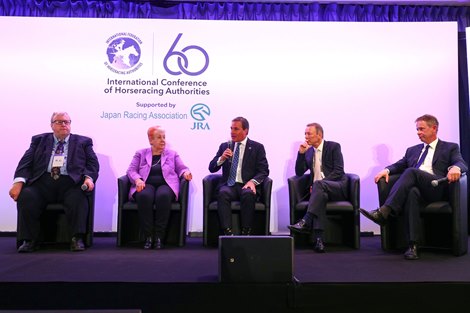
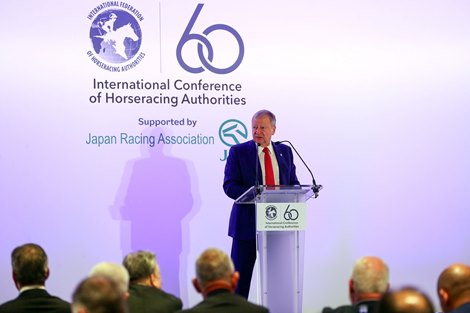
IFHA chair Winfried Engelbrecht-Bresges then led the second session of the conference with an address exploring the IFHA's transition to becoming a more active global leadership organization, as well as the major challenges currently facing the sport. Topics he covered included widening the sport's fanbase, the sustainability of the Thoroughbred, and tackling threats to racing's funding structure.
"In this time of great social, political, and economic uncertainties, and significant challenges to our sport's relevance and sustainability, it is more important than ever that we unite as an international racing community," Engelbrecht-Bresges said. "The future of horse racing can only be secured by working together to address the key challenges that we face, and the IFHA is at the heart of that coordinated, collective action that we must pursue."
Engelbrecht-Bresges then took part in a panel discussion focused on leading racing toward a strong and sustainable future.
The other panelists were Masayuki Goto, executive adviser for the Japan Racing Association and IFHA Vice-Chair; Guillaume de Saint-Seine, president of France Galop; Everett Dobson, chairman of The Jockey Club (U.S.); Suzanne Eade, CEO of Horse Racing Ireland; Felicity Barnard, CEO of Ascot; Teddy Grimthorpe, chair of the International Thoroughbred Breeders' Federation; and Vee Moodley, CEO of the National Horseracing Authority of Southern Africa.
To close the conference, Engelbrecht-Bresges honored the late Louis Romanet, chairman emeritus of the IFHA, who died in March.
"Ultimately, the federation exists because racing authorities recognize that, although our jurisdictions may be different the future of the sport is a shared responsibility," Engelbrecht-Bresges said. "That principle was at the heart of Louis Romanet's work. Louis will be missed dearly, but his legacy will endure throughout the global racing community that he worked so tirelessly to unite."
A replay of the live video stream and presentations will be available in the coming days. BloodHorse plans to post it at BloodHorse.com.
This press release has been edited for content and style by BloodHorse Staff.