

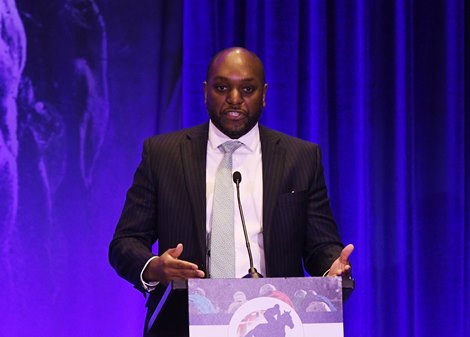
Following the Oct. 7 announcement that Najja Thompson is joining The Jockey Club in a newly created role as director of state breeder and provincial programs, BloodHorse news editor Byron King spoke with Thompson about his new role and his departure from the New York Thoroughbred Breeders, where he has served as executive director since 2020.
In the following exchanges, he discusses the importance of supporting regional, state, and provincial breeding programs, and continued efforts to increase the foal crop and the number of racehorses reaching the racetrack.
The following question-and-answer session is edited for brevity and clarity.
BloodHorse: Tell me about this new role and how it all came together.
Najja Thompson: At the last Jockey Club Round Table, chairman Everett Dobson, towards the end of the conference, talked about The Jockey Club creating this new role, which would be with the intended goal of supporting our industry and regional state breeding programs, as well as provincial programs in Canada ... increasing the foal crop, helping respective jurisdictions handle issues, such as legislative issues supporting breeding programs. The Jockey Club certainly wants to play a bigger role in getting that done, helping respective jurisdictions and helping our sport overall. I'm thankful to The Jockey Club for the opportunity to help lead that effort and (for the support) of the whole organization as well.
BH: Obviously, you haven't started yet, but what ideas are circulating in your brain that might prove to be exciting opportunities?
NT: I think first it's going to take a big analytical effort in certainly researching how we can best make an impact. We know we need the support of more mares. We know we need the support of regional stallions to do well and, of course, (we are) looking at each respective jurisdiction, looking at the legislative issues going on in each respective area, and how the industry can best be supported to encourage participation. We want to encourage ownership. We want to encourage breeding, and I think that role is certainly set forth with having measurable benchmarks that I will go into with the management team and the stewards at The Jockey Club and ensure that we can provide the best support in continuing to help to move our industry forward.
BH: Each state breeding program is often unique. They all have different headwinds and challenges, or different incentives. What might suit New York might be different than what suits California. Give me your thoughts on those unique dynamics.
NT: I think you're exactly right. I think the first step is going in and listening to the stakeholders, listening to the participants in each respective jurisdiction, hearing their feedback, and then analyzing their concerns and where the best impact can be made in working through the overarching goal of increasing the foal crop, creating more racehorses that make it to the racetrack, and support each respective area, whether that be issues in California versus issues in Florida versus issues in each respective state. This will lead back to the overall goal of what we want to do.
In speaking with everyone at The Jockey Club—Everett Dobson, Jim Gagliano, Charlotte Weber—and I'm sure the stewards as well, (an aim is) having The Jockey Club directly lend a hand and becoming more actively involved in making sure that each state program and provincial program feels the support of The Jockey Club as the breed registry.
BH: I presume this new position will put you on the road a little bit. Will New York still be your home base? How much traveling will you be doing?
NT: I expect to do a ton of traveling, which I'm looking forward to. The home base for me will be out of the New York office, but I certainly will be accessible and on the road. And it's about getting face-to-face with the stakeholders in each respective jurisdiction, so I plan to do that directly.
And of course, The Jockey Club has previously, especially with the efforts of Jamie Hayden, hosted breeder workshops. So we're looking to expand upon those. We're looking on planning to have the second annual breeder workshop later this year, so that's another effort where we're getting individuals and programs together to see what partnerships can be created.
You've seen a lot of interaction between jurisdictions, whether that be Woodbine and the New York Racing Association in New York. You've seen Virginia and Maryland create great concepts of working together. So that'll be a part of the role as well to see how we can get these jurisdictions to work together and make sure that we can support the growth of our horse population nationally and, of course, that we have a program that can support all regions and be successful throughout the year.
BH: Lastly, you've spent your recent years as the executive director for New York Thoroughbred Breeders. What do you consider to be the highlights of your time there? Reflect on the state breeding program as you move on to a new endeavor.
NT: I think New York has been certainly a benchmark of a program that's seen itself improve with continued increases in the foal crop and continued increase in the stallions that are standing in the state. That's the great work that we've been able to do through the state legislature, through our partners, whether that be Finger Lakes racetrack in Western New York or the New York Racing Association, of course, all year.
We've seen this year the redevelopment and opening of the new Belmont Park, which was a big, huge effort that we worked together as an industry to get done. And some of the highlights for me, of course, are going to be historic purse levels for New York-breds on the NYRA circuit, running for equal purses as open-company horses. That has encouraged participation across the state of New York, and really everything that we've done in increasing year to year the foal crop, which is no small feat, in the current state and circumstances of the industry overall. ... So I'm looking to take those tools and hopefully apply them in visiting other jurisdictions to see how we can make a movement overall nationally.