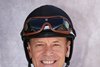


Don Pierce was the real deal, a pro's pro. Just ask around.
"Everybody respected Don," said Laffit Pincay Jr., who went boot-to-boot with Pierce for nearly 20 years and never let himself believe he had the edge.
"When he had a good horse and started working on him, you knew he would respond," Pincay said. "You would get to him and think you had him, but you didn't. When he started whipping left-handed, he was tough to go by."
But an easy guy to like. Between the rails, Pierce was the ultimate competitor. On the ground, he brimmed with down-home, bad-boy charm, ever ready with a good line or a sly prank, often in cahoots with Bill Shoemaker, his running mate.
"When I came here in 1970, Pierce and Shoe were on the top of the game," said Fernando Toro, who landed in California from his native Chile by way of Florida. "If Shoe didn't ride the good horse, it was usually Don."
Zipping around town in his Mercedes sport coupe decorated with a license plate that read "WIN DP," Pierce earned a reputation as a primetime athlete always at his best with serious stakes money on the line. His death Oct. 5, at age 89, has been a chance for renewed appreciation of a career that spanned the old-school days of Eddie Arcaro and John Longden to a generation of younger guns led by Chris McCarron, Gary Stevens, and Eddie Delahoussaye.
READ: Hall of Fame Jockey Pierce Dies at 89
Some records, though, take time to simmer. Don Pierce was not voted into the Hall of Fame at the National Museum of Racing until 2010, by way of the Historical Review Committee, at which point he had been retired for 25 years. A committee member took one look at the list of significant stakes races won by the man from Clebit, Okla., and wondered aloud, "How is this guy not already in the Hall?"
In "The Shoe," written in 1976 with Del Mar publicity chief Dan Smith, Bill Shoemaker commented on a litany of riding colleagues—Arcaro, Bill Hartack, Ralph Neves, Braulio Baeza—before finally landing on his closest brother in arms, summing things up with unequivocal praise in a brief paragraph so as not to unduly embarrass his pal.
"Don Pierce is one of the best," Shoe told Smith. "I think he's underrated, and he doesn't get the chance he deserves considering the caliber of rider he is. The proof is that when he does get the opportunity in a big race, he's always right there on the money. Yet, he's never received proper recognition."
Blame Shoe for some of that. So much of what Pierce accomplished played out in the shadow of his superstar friend. By 1958, Shoemaker had done enough to be elected to the Hall of Fame, at age 27. That same year, the 21-year-old Pierce won his first major Southern California stakes aboard Noredski in the Del Mar Handicap.
It was not long, though, before top trainers began trusting Pierce with their best. At one time or another he rode Kelso, Native Diver, Ack Ack, Ancient Title, Silky Sullivan, Exceller, Typecast, Quack, Crimson Satan, and Pink Pigeon.
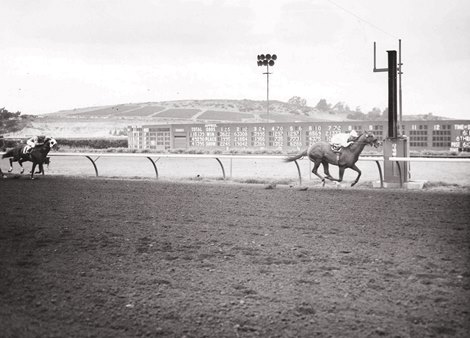
But Pierce never won a Triple Crown classic, and he was not around long enough to enjoy the fruits of the Breeders' Cup, the benchmark for contemporary riders. Surrounded on all sides by Hall of Famers, beating them as often as not, it seemed as if fate had other versions of fame in store.
In 1964, Pierce and the towering California colt Hill Rise were unbeatable. They cruised through the winter out West and overpowered the Santa Anita Derby to loom a threat to Northern Dancer in the Kentucky Derby and beyond.
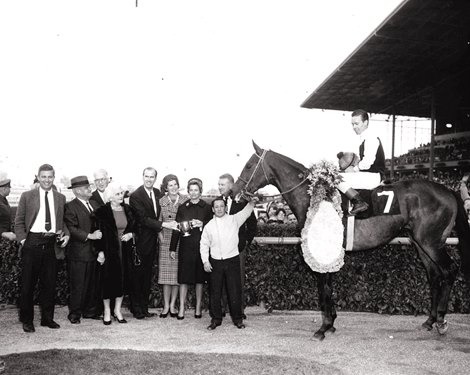
Pierce also knew that George Pope Jr., the breeder and owner of Hill Rise, had been courting Shoemaker for the Derby, and the Santa Anita Derby performance sealed the deal. Shoe jumped off Northern Dancer to displace Pierce on Hill Rise but then, in a wicked twist, Northern Dancer and Hartack defeated Hill Rise and Shoemaker by a dwindling neck at Churchill Downs.
"Shoe later told me he thought I would have won the Derby on Hill Rise, because I knew him so well," said Pierce, which was some consolation.
Years later, Pierce and Flying Paster ran roughshod over their opposition out West to pose what looked like a legitimate threat to Spectacular Bid in the 1979 Kentucky Derby. Alas, the Californian was no match for The Bid, but few were.
Fans of Pierce had to be content with his almost weekly array of live mounts in marquee races through the late '60s and across the '70s at Santa Anita, Hollywood Park, and Del Mar. He gave Princessnesian a picture-perfect ride to beat colts in the 1968 Hollywood Gold Cup Handicap. He helped the gray mare La Zanzara defy gender prejudice in the 1975 San Juan Capistrano Invitational Handicap (G1T). That same year, Pierce teamed with Neil Drysdale and Forceten to humble Diabolo and Avatar in the Swaps Stakes (G1).
Through one strange and wonderful stretch of time in the early 1970s, he rode every good 3-year-old filly in the West. Pierce and Sandy Blue. Pierce and Taisez Vous. Pierce and B. Thoughtful, Princess Karenda, Modus Vivendi.
At the peak of his powers, he won the precious Santa Anita Handicap four times—behind only Shoemaker and Pincay—and the last of those four thanks to a work of riding art aboard the opinionated Triple Bend in 1972.
"In the race before that, Triple Bend pulled himself up when Don hit him," said Dan Smith, head of the Santa Anita publicity department at the time. "Now he's going a mile and a quarter, but Pierce has the discipline to keep from using his stick, despite the accepted conventions. He was a strong finisher anyway, and he had to be that day."
After racing on the lead alongside Unconscious and Angel Cordero Jr., Pierce and Triple Bend held off the onrushing Cougar II, under Shoemaker, to win by a head.

In 1973, before the schedule was glutted with stakes, Pierce bagged 32, good for tops in the United States in the face of Shoemaker, Pincay, Cordero, and Ron Turcotte, who was riding both Secretariat and Riva Ridge.
However, the race he didn't win still burns brightest, at least in the memories of those of us who were in Arcadia on that overcast afternoon in March 1973, when Pierce and Kennedy Road, a champion in Canada, lost the Santa Anita Handicap by a whisker to Pincay, who was subbing for the injured Shoemaker aboard Cougar II.
Pincay survived a stewards' inquiry that day, but he had not been so lucky when he tangled with Pierce in the 1970 Los Angeles Handicap at Hollywood Park. After a ferocious stretch duel, Pincay and Right or Wrong edged Pierce and favored Ack Ack by a nose at the end of the 7 furlongs.
"I thought he came in on me first, so I started pushing him out, and it was me who got disqualified," said Pincay, although Pierce, were he available, might disagree. "That pissed me off."
Fernando Toro, who had just arrived from Florida, was nearby when the two riders entered the tunnel leading from the paddock to the room.
"I had never seen two jockeys fight before," Toro said. "They were talking back and forth, getting madder and madder, then they started rolling around all over the tunnel. It looked like they were trying to kill each other. The clerk of the scales said, 'Let them fight, they'll get tired.' But they kept going. Funny thing was, after they finally stopped neither one had even a scratch."
Pincay laughed at the memory.
"As we aged, we got so friendly," Pincay said. "We respected each other. I'll never forget the day he retired. When I heard, tears came to my eyes. I got really sad. I would never see him in the jocks' room again, and I knew I would miss him."
That day came on New Year's Day 1985. Without fanfare, Pierce stepped away at the age of 47 with 3,546 winners over a 30-year career and hung out a shingle as a public trainer. Later, Pierce took on the book of David Flores as agent, then contented himself in his later years with lots of golf, visits to Del Mar, and participation in reunions through events such as Jockeys and Jeans to benefit the Permanently Disabled Jockeys Fund.
"I rode Don's first winner as a trainer," said Sandy Hawley, who became a California regular in the late 1970s. The horse was Erb Prinz in a straight maiden event at Santa Anita. It was the least Pierce could do.
"When I first came to California from Canada, I played golf with Don and Shoemaker in a fivesome," Hawley recalled. "I didn't know much about betting golf, and Don had a few different team games going. When we finished, he spent half an hour to figure out the score. I asked him why it was taking to long. He told me I owed seventy dollars, and I only had fifty on me at the time.
"I was very respectful of Don," Hawley added. "I'd only been in California a few weeks when I watched him ride a race so perfectly that I had to tell him so. I think he appreciated that. The only problem was, when I'd get on the scale, if he was behind me he hit me on the elbow with his knuckle."
This was straight out of the Shoemaker-Pierce playbook—grown men in a blood sport keeping things light—along with hot spoons on the back of the neck and shaving cream in somebody's boot. A lover of life ("He was an all-around athlete and a terrific dancer," Smith said) and loyal to a fault, to his everlasting credit there is more than one way to remember Don Pierce.
"To this day," Hawley said with a laugh, "my damn funny bone is still a little tender."