

After 42 years' worth of Breeders' Cup Championships—40 of them witnessed up close and sometimes very personal—you would think this racing fan by now would be accustomed to the roller coaster ride of unfolding dramas as the grand event looms each autumn.
But no matter how tightly you buckle up, there remain gaping potholes waiting to swallow even the most ironclad expectations. For consolation, there is comfort in the fact that those two brilliant days of sport will finally arrive—in this case, Oct. 30 and 31, at Keeneland—with their 14 races guaranteed to wash away the residue of any disappointments. The trick is getting there.
The loss of Irad Ortiz Jr. to the 43rd Breeders' Cup celebration represents a brutal blow. The broken ankle he sustained Oct. 22 at Keeneland will mend, and even Ortiz will insist it could have been worse. Still, a Breeders' Cup without Ortiz is like the original "The Producers" on Broadway with an understudy stepping in for Nathan Lane. Ortiz is one of those athletes that stirs the mix, attested by the 23 wins that rank second only to Mike Smith in Breeders' Cup history.
The injury to Ortiz rang distant, discordant bells. Gary Stevens, all of 22, was less than three weeks away from his second Breeders' Cup experience in 1985 when he was tossed and dragged by his panicked mount during a workout at Santa Anita Park. A shoulder and knee took the worst of the experience, and both plagued Stevens for the rest of his Hall of Fame career.
One year later, it was Chris McCarron's turn to go down on the threshold of the Breeders' Cup. McCarron was the nation's leading rider at the time, but that was no defense against a grizzly incident on the final turn of a race at Santa Anita Park just 16 days before the Cup. The most serious of his various injuries was a broken femur that turned him into a TV analyst for the big day.
The femur, running the length of the thigh, is the largest, longest, and strongest bone of the human body. It takes a lot to break one and a lot of time to heal. Ryan Moore was knocked out of action for the wrong two months last year because of a stress fracture to his right femur that rendered the Breeders' Cup at Del Mar without one of Europe's most celebrated riders. The good news is that Moore and his 16 Breeders' Cup trophies will be back next week at Keeneland.
So will Brian Hernandez Jr., who missed the 2025 Cup after he was trampled by his falling mount in a Churchill Downs race that September. The damage included a collapsed lung, lacerated liver, and several broken ribs. Somehow, Hernandez made it back to the races in less than two months.
Equine defections are just as hard to swallow. Those of us present for the Breeders' Cup origin story of 1984 were inoculated early by the impact of the soft tissue injury that took John Henry out of the inaugural Breeders' Cup Turf (G1T). The gut punch removed America's reigning Thoroughbred hero from the stage when the newborn event needed his big shoulders to help carry the burden of legitimacy.
Reality bites, though, and the show went on. There was another stern test of Breeders' Cup resilience in 1997 when Skip Away, Formal Gold, and Gentlemen—the nation's top three older horses—were primed for a showdown in the Breeders' Cup Classic (G1). Then Formal Gold was injured and Gentlemen fell sick, leaving Skip Away to gallop home. A nickel to anyone remembering who finished second, without googling.
At that same '97 event, there still was a chance the international star Singspiel could save the day, at least in terms of drawing power. Alas, on a foggy morning at Hollywood Park just two days before his scheduled start as the favorite in the Turf, he sustained a condylar fracture of his right foreleg during a finishing-touch breeze over the Hollywood Park turf course.
Michael Stoute, Singspiel's trainer, erased a bit of that bad taste with Kalanisi's win in the 2000 Turf and Conduit's Turf wins of 2008 and 2009. In 2010, Stoute looked like a three-peat cinch at Churchill Downs with Workforce, winner of the Epsom Derby (G1) and Prix de l'Arc de Triomphe (G1), Europe's most coveted double. A dry summer had baked the course hard, however, and no amount of watering seemed to slake its thirst. Once burned was enough for Stoute, and Workforce was scratched the morning of the race.
The beat went on. Champion mare Beholder, fresh from her towering score in the Pacific Classic Stakes (G1), figured to give American Pharoah a run for his money in the 2015 Classic at Keeneland. Then she bled during a gallop the week of the race and stayed in the barn. In 2023, the Classic lost Belmont Stakes (G1) and Travers Stakes (G1) winner Arcangelo to an unresolved issue with a hind foot. He never raced again. And just last year, the Classic at Del Mar was stunned when heavily favored Sovereignty spiked an untimely fever.
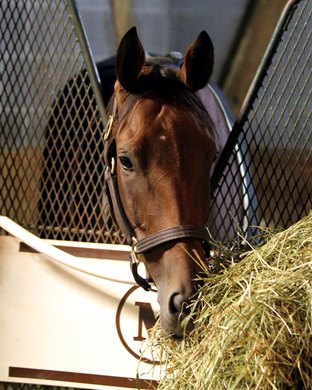
Oct. 27 marks the 25th anniversary of Tiznow's second straight Classic triumph, by a nose over Godolphin's Arc de Triomphe winner Sakhee at the old Belmont Park. In the department of small favors, Sovereignty's scratch in 2025 at least helped pave the way for the historic victory of Forever Young, and now the Japanese horse will try to join Tiznow as the only two-time winners of the Classic when he goes postward Oct. 31.
Some lemons take longer to become lemonade. With the absence of John Henry in the 1984 Turf, all eyes fell upon Seattle Song, the French invader who had just won the Washington, D. C., International (G1T) when the Laurel Park event was still a big deal. As that first Breeders' Cup week unfolded, these eyes looked up from a keyboard just in time to watch Seattle Song fracture a cannon bone during a workout that sent the son of Seattle Slew into retirement.
The first foals of Seattle Song arrived in 1986. Among them was a filly named after her owner and breeder, Cecilia Straub-Rubens. Cee's Song won only once in 18 starts, but with eight seconds and three thirds she deserved a chance to improve the breed. Her second foal was Budroyale, a winner of $2.8 million who finished second in the 1999 Classic at Gulfstream Park. Foal number six came along in 1997. His name was—and still is—Tiznow.