

With Dubai World Cup (G1) night upon us, it's worth a look at the value of the big-ticket, superstar race meetings that now define the global racing schedule.
When last we met, the discussion centered on boosting interest in international racing by showcasing superstar horses—a valid approach, to be sure, but one that really wouldn't be the same without those race meetings.
After all, you can't showcase horses without a show.
The world has come a long way in the past several decades in terms of building those shows, from the specialty shops of Royal Ascot and Prix de l'Arc de Triomphe (G1) meetings through Dubai World Cup and Saudi Cup (G1) programs.
The breakthrough, though, obviously, is the Breeders' Cup World Championships. A success from the first running at Hollywood Park in 1984, "Breeders' Cup?" has become the standard question about plans for any breakout star virtually anywhere in the world.
And as the meeting has doubled in size, from one day with seven races to two days and 14 races, participation by connections around the world has grown apace with attention by fans from all parts of the globe.
Other meetings have been notably successful, of course, with the Dubai World Cup breaking ground in the Middle East, now joined by the Saudi Cup and other jurisdictions. But Breeders' Cup is different. And there are several reasons why, including horse recruitment; consistent, aggressive, and up-to-the-minute marketing; and circumstantial factors such as variable location and timing within the annual international racing calendar.
Without international participation, there would have been no "World Championships," and the early Breeders' Cup benefited mightily from the recruitment and logistical support of the International Racing Bureau. Little known to average fans, the Newmarket-based IRB has been instrumental in launching virtually all the big-ticket international race meetings, including Arlington Park's International Festival of Racing and Breeders' Cup from their get-go.
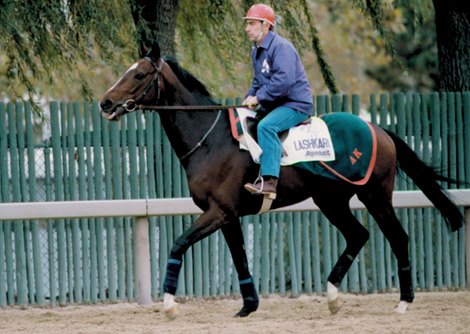
The inaugural running at Hollywood Park produced the first foreign winner—Lashkari (GB). It doesn't get more international than owner/breeder The Aga Khan, trainer Alain de Royer-Dupre, and jockey Yves Saint-Martin.
Breeders' Cup built on that with the institution of the international Breeders' Cup Challenge Series: Win and You're In races around the world—that program now extends to 14 countries, with 45 of them run at tracks outside of North America and 50 in North America. The winner of each is guaranteed a fees-paid entry to a corresponding event on the big day and a travel allowance to get there. That expansion, now emulated with variations by other jurisdictions, has taken Breeders' Cup well past its origins.
"At Breeders' Cup, global participation is a key part of our foundation and the first step in our flywheel," Justin McDonald, executive vice president and chief marketing officer, told delegates to the Asian Racing Conference in Riyadh, Saudi Arabia, in the lead-up to this year's Saudi Cup. More than 600 delegates from 40 regions and jurisdictions attended.
"For many years, we have made a deliberate investment in expanding international participation through direct recruiting efforts and the expansion of our Breeders' Cup Challenge Series."
The effort has taken the organization far beyond its origins with the IRB.
"The Challenge does get more runners thinking about Breeders' Cup from global locations and that's a good thing," said Adrian Beaumont, IRB's director of racecourse services. "Most of our work (now) is done in the last month as we run up to pre-entries and on the ground. ... It's a big and complicated event now."
Has it worked?
"In 2025, the Breeders' Cup World Championships featured 49 international runners from 12 countries—one of the deepest and most diverse international fields in our history," McDonald said. "That's a 48% increase in international starters over the past five years. Not by coincidence, that increase ties directly to a 44% increase in International Challenge races over the same five-year period."
The second tool in winning global attention, after getting the horses, is marketing outreach, and McDonald said Breeders' Cup continuously updates its efforts to touch a changing fan base through evolving technology.
"The Challenge Series allows us to do just that—connect the Breeders' Cup brand to major races around the world and begin storytelling well before Championship week. Breeders' Cup now becomes an active marketing partner with major racing festivals domestically and around the world, promoting their races across our channels to help grow global awareness and interest in our sport," he said.
The organization pursues this through pushing "non-live" content—stories about the horses and connections—to augment an ever-growing worldwide live event distribution network keyed by expanded partnerships with the Hong Kong Jockey Club and Japan Racing Association.
On March 22, Breeders' Cup announced a new "Road to the Cup" series designed to shape storylines leading up to this year's event Oct. 30-31 at Keeneland.
"In 2025, we had 148 million impressions, 83 million views, and 4.5 million engagements across our social platforms, with total followers nearing 1 million," McDonald told the ARC audience.
And all of those factors, he said, have fallen into place in the past two years around Japan's superstar and reigning Breeders' Cup Classic (G1) winner Forever Young.
"I'll come back to where I started," he concluded the presentation. "It all starts with the horse."
Which is where we started last month.
Loss of a Leader
Somewhat belatedly, we note and mourn the passing of Louis Romanet, chairman emeritus of the International Federation of Horseracing Authorities. Romanet died March 4 at age 78 but his influence on the global racing scene will live on for many years.
"Louis was a friend and mentor to me for more than 40 years, and he was the most respected and globally recognized figure in international racing for decades," said Winfried Engelbrecht-Bresges, chair of the IFHA. "He was a friend to all, a passionate and caring leader, and a mentor to many across our industry. He will be missed dearly, and his legacy will endure throughout the worldwide racing community he worked so tirelessly to unite."
READ: Racing Visionary, Global Leader Romanet Dies at 78
Romanet became chairman of the IFHA at its creation in 1994 and held that position for more than 25 years. During his tenure, the IFHA evolved into the leading global forum for cooperation among racing authorities and created and/or developed many of the committees and partnerships, both formal and informal, that make international racing possible.
Among many others, his hand was prominent in IFHA's International Movement of Horses Committee, the International Grading and Race Planning Advisory Committee, the Committee for the Harmonization of Raceday Rules, the Longines World's Best Racehorse Rankings Committee, and the International Conference for the Health, Safety and Welfare of Jockeys.
He was a driving force in securing IFHA's sponsorship agreement with Longines, which grew to include the Longines World's Best Racehorse, World's Best Horse Race, and World's Best Jockey awards.
A force in French racing before his involvement in the IFHA, he became director of organization and international affairs for France Galop upon its creation in 1995 and served as director general from 1998 until his retirement in 2007.
Romanet's stuffed awards case includes his appointment as Officer of the Legion of Honor in France, the Gold Medal of The Jockey Club in the United States, and Japan's Order of the Rising Sun.